
Eight Factory Steps Behind a Custom Jewelry Order
A custom order moves through eight named steps: from the concept and CAD stage and the prototype stage through cutting the sprue, gloss polishing and textured surface art to the plating step, final QC inspection and final delivery. Only three of them come with a published clock — CAD CAD 48 hours for drawings, 25–30 days to a sample, then 3–4 weeks of production of production — CAD, sample, run — CAD, sample, run for mass production. The other five decide whether those clocks survive contact with a real batch.
Key takeaways
- Five of the eight steps carry no published duration; the three that do are CAD at under 48 hours, sampling at 25–30 days and production at 3–4 weeks.
- Sprue cutting, polishing and surface art sit between prototyping and the plating tank, which is why a heavy casting shows up as extra bench time.
- The step before delivery is a 100% final inspection, so coverage is the promise rather than a sample of the batch.
- Minimums are 100+ pieces in stainless, 100 in artisan eco-brass and 50 pcs in 925 sterling silver, design by design.
Why the running order matters more than the list
The eight steps are published in sequence by TTT Jewelry, and the sequence is the useful part. Concept design happens twice, first as a hand drawing and then as CAD. Prototyping follows, done by mould or by 3D printing. Sprue cutting strips the feeding channels off the casting, polishing brings the surface up to a high gloss, and surface art adds the brushed or textured look.
Read that as a chain rather than a checklist and one rule appears: anything that changes the shape of the metal has to be settled before the finishing stages start. A ring that gains weight at casting is not fixed at the polishing wheel; it is recast. That is the point in the chain where a design change costs days instead of screen time.
Three steps carry a clock, five carry the risk
3D CAD modelling is quoted at under 48 hours because it produces a drawing and a render rather than metal. The master sample is quoted at 25–30 days and covers the 3D wax print through casting in a precision mould and stone setting to polishing and custom electroplating. Bulk production after sign-off runs 3–4 weeks, depending on batch volume and design complexity.
Prototyping, sprue cutting, surface art and final inspection have no published duration because they depend on the batch in front of the bench. What they have instead is a position: a fault caught at the inspection stage holds the whole carton, while the same fault caught straight after casting costs only the castings.
What each step is worth asking about
| Step | Published clock | The question it answers |
|---|---|---|
| Concept design, hand and CAD | Under 48 hours | Can the dimensions be approved from a screen? |
| Prototyping and sprue cutting | Not published | Is the casting clean enough to finish? |
| Polishing and surface art | Not published | Which finish is being quoted, gloss or brushed? |
| Electroplating | Not published | Gold layer, rhodium, or anti-tarnish e-coating? |
| Final QC and delivery | Not published | Does the 100% inspection happen before packing? |
Reading the three windows in one unit
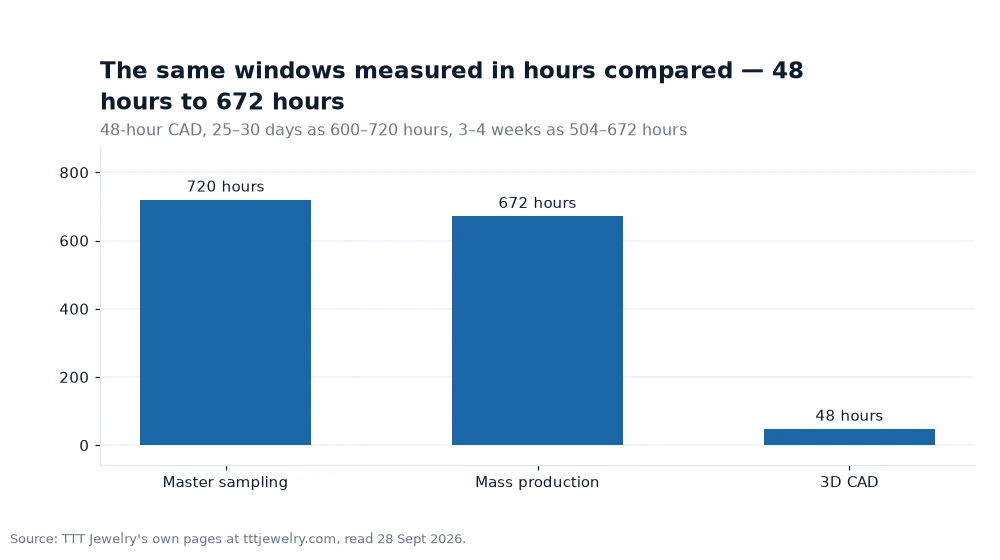
The published windows only line up once they are converted. Sampling at 25–30 days is 600–720 hours. Production at 3–4 weeks is 504–672 hours. CAD is under 48 hours, roughly one fifteenth of the sampling window at its slow end. That ratio explains why a design question is cheap at the start of an order and expensive two weeks in, and why a custom jewelry manufacturer that pushes revisions into the CAD stage keeps more of the calendar free.
Nothing in the published figures is unusual. What is unusual is a supplier that will put the three windows side by side in front of a buyer, because doing that makes the aggressive answers from other suppliers look like what they are.
Worked example: the whole order in hours
Take the slow end of every published window: 48 hours of CAD, 720 hours of sampling and 672 hours of production. That is 48 + 720 + 672 = 1,440 hours, which is 60 days, or about 8.6 weeks. Swap in the fast ends — 48 + 600 + 504 — and the same order fits into 1,152 hours, or 48 days.
So the published spread between a smooth order and a slow one is roughly twelve days. None of that spread comes from the eight steps themselves; it comes from how quickly drawings and samples get approved at each gate. Add two weeks of internal review on your own side and the twelve days disappear into your calendar rather than the factory's.
Where the last step sits in the batch
Final QC is described as 100% inspection, which is a statement about coverage. In practice it means every piece in the carton has been checked against the approved sample, marked with the relevant purity hallmark — 316L for stainless steel, 18KGP on gold-plated work and the S925 hallmark — and packed only after that pass.
Ask for the inspection note with the shipment. A factory that documents its last step can say which pieces were pulled and why, and that note is the one part of the chain a buyer sitting in another country can actually audit.
What the words tooling and sprue actually buy
The mould is the part of the process a buyer pays for once and reuses for as long as the design lives. It is cut during prototyping, reused at casting on every repeat order, and it stays exclusive to your brand under a 100% NDA. That is why a repeat order skips the first two steps entirely: nothing new has to be tooled.
Sprue cutting is the step that tells you whether anyone is watching the casting bench. Sprues are the channels that feed molten metal into the mould, and they leave stubs that must come off before polishing. Cut them badly and the stub becomes a flat spot no polishing wheel can recover, which turns a bench operation into a second casting run.
Two numbers from the buyer's side of the table
The published schedule assumes two approvals happen quickly: the CAD drawing and the physical sample. Both belong to the buyer. If a technical drawing sits in an inbox for a week, the 48-hour CAD stage becomes an eight-day one, and the eight factory steps are unchanged while the order is nine days later.
So set one internal rule before the first order. Name the person who signs off dimensions, and make sure that person is reachable inside two working days. In an order whose whole published spread between a fast run and a slow one is about twelve days, that rule buys both of them back.
Frequently asked questions
How long does a custom jewelry order take from sketch to shipment?
Under 48 hours for CAD, 25–30 days for the master sample, and 3–4 weeks for bulk production once the sample is approved — about seven to nine weeks, plus your own approval time at each gate.
Which of the eight steps has no published duration?
Prototyping, sprue cutting, polishing, surface art and final QC. Their timing depends on the batch, so the factory publishes windows only for CAD, sampling and production.
Does a repeat order run all eight steps again?
No. A repeat of a design already tooled skips concept design and prototyping, because the mould exists, so the calendar starts at casting and runs through finishing, inspection and delivery.
How to use the eight steps in a supplier conversation
Ask any supplier to name the steps in order and to say which of them happens on their own floor. That answer separates a workshop that owns its sprue cutting and polishing benches from a trader that forwards your file and waits for a quote. TTT Jewelry publishes the sequence, the three windows and the minimums; the OEM/ODM routes spell out who signs at each gate, and the factory floor tour shows where each step is carried out.
The figures used above — the eight steps in production plus the six customisation options and the approved-sample benchmark — are drawn from the client's own website via tttjewelry.com on 28 Sept 2026. The hourly and weekly restatements are mine, while the source figures stay the client's[1].