
316L Jewelry Manufacturing: Hallmarks and Compliance
316L is a low-carbon stainless grade with 2–3% molybdenum, and a stamp on a finished piece is a claim about the alloy rather than about the coating above it. Marks are laser engraved, and the published set is S925, 316L and 18KGP. Behind the mark sit four published positions: ISO 9001:2015, BSCI, REACH and CA Prop 65, with a stainless steel MOQ of 100+ pieces per design.

Key takeaways
- 316L denotes low carbon plus 2–3% molybdenum, not a coating or a finish.
- Published marks are S925, 316L and 18KGP, applied by laser engraving.
- REACH restricts lead, cadmium and nickel; plating is stated as 100% compliant with REACH and CA Prop 65.
- Stainless MOQ is 100+ pieces per design, with 100% inspection before delivery.
What the 316L stamp does and does not say
The L in 316L stands for low carbon. The lower carbon content limits carbide formation during heating, which is why the grade is common in applications where parts are joined or stressed. On a piece of jewelry, the stamp tells a buyer that the bulk alloy is that grade.
It does not tell them that the chain is solid, that the clasp is the same alloy, or that the coating is a particular thickness. Those are separate lines on a specification. A hollow pendant and a solid one can both carry a 316L mark, and their service lives differ.
That matters in a market where stainless steel serves as a general word. 304 and 316L are both stainless, both described as nickel and lead safe, and they are not interchangeable for a swim product. One carries molybdenum at 2–3%; the other is published as water-resistant for daily wear.
The mark set and where it lands
The published hallmark options are S925 for sterling, 316L for stainless and 18KGP for gold plated, applied by laser engraving. The order of operations matters. Engraving after plating puts a mark on the coated surface, and the mark is a shallow line rather than a struck impression.
Placement is a design decision. Inside a ring band, on a clasp tag, on the back of a pendant: each position carries different wear exposure and a different amount of clear space. A mark on a high-polish face reads clearly at first and collects dirt later. A mark on the back plate costs nothing in appearance and keeps the information legible.
Size is the other constraint. Laser engraving can hold fine detail, but a mark that is too small to read at arm's length defeats its purpose. A buyer should approve the mark on a physical sample rather than on a screen render, because the render always looks sharper than the engraved line.
What the compliance stack covers
ISO 9001:2015 covers the management system across production stages, which is a process claim. BSCI covers labour and social audit, which is a workplace claim. REACH covers restricted substances, with lead, cadmium and nickel named in the published position. CA Prop 65 covers the United States disclosure route, and plating is stated as 100% compliant with both REACH and CA Prop 65.
Read together, the four describe different things: how the factory is run, how the people are treated, what the materials contain and what the US market requires. A buyer who needs only one of them for a particular retailer should still hold all four, because a compliance questionnaire tends to arrive after the purchase order rather than before it.
The practical file is small: the certificate scope, the audit status, the substance statement and the plating declaration, each tied to the supplier and the date. A file that cannot be dated is a file that cannot be defended.
The questions to settle before a quotation
Three items fix the route: the alloy, the mark and the finish. A stainless piece marked 316L with a PVD colour, a sterling piece marked S925 with rhodium, and a brass piece marked 18KGP with gold plating are three production plans with three different minimums.
A buyer can get a quote that means something only after those three are written down. The same applies to packaging: a barcode label and a metallic logo tag are separate line items, and neither changes the metal specification. Buyers planning repeat programmes can compare the custom jewelry wholesale structure, where the mark and the packing list are already set.
One more question is worth asking early: who owns the tooling and the CAD. The published position is that designs are exclusive to the brand, with moulds and CAD not resold or shown, and a 100% NDA covering the programme.
The table pairs each published mark or claim with the assertion behind it and the item a buyer should ask to see.
| Mark or claim | What it asserts | What to verify |
|---|---|---|
| 316L | Low-carbon stainless with 2–3% molybdenum | Grade on the drawing and the mark |
| S925 | 925 sterling silver | Alloy and the anti-tarnish e-coat |
| 18KGP | Gold plated | Plating route and colour target |
| REACH | Lead, cadmium and nickel restricted | Current substance statement |
| ISO 9001:2015 | Quality system across production | Scope of the certificate |
| BSCI | Labour and social audit | Audit status and date |
Two entries in that table are commonly confused. A mark identifies a material; a compliance statement identifies a supply chain. A piece can carry a correct 316L mark and still sit in a shipment whose paperwork has expired, and the two facts are checked in different places.
Worked example
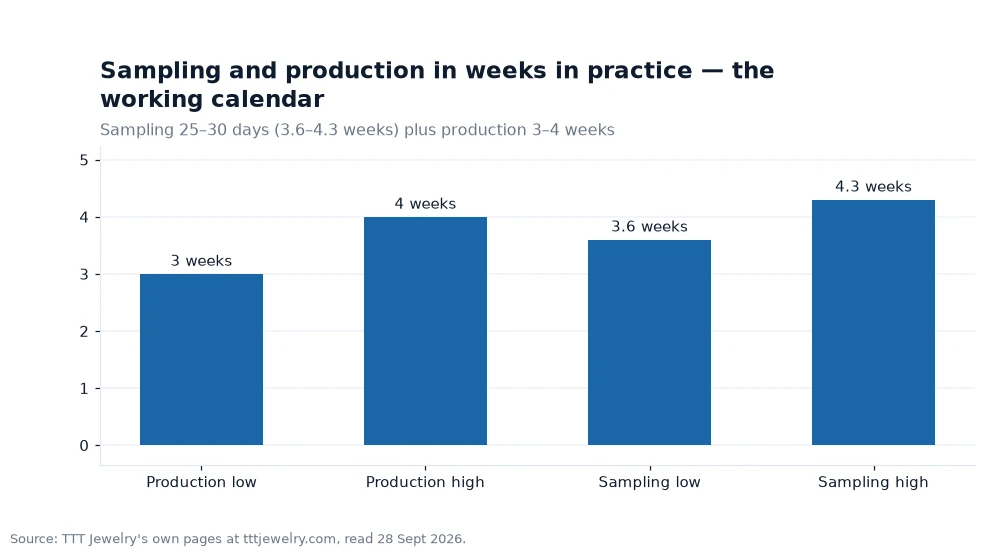
The schedule arithmetic is short. CAD is under 48 hours and sampling is 25–30 days. As a share, 48/600 = 8% at 25 days and 48/720 = 6.7% at 30 days, so the modelling block is under a tenth of the bench block. Add production at 21–28 days and the total is 48–60 days.
Quantity follows the same per-design rule. Three stainless designs at 100+ pieces is at least 300 units; three sterling designs at 50 pieces is 150. The same launch, the same design count, twice the quantity in stainless, and 100% inspection applies to every unit in both cases.
That difference of 150 units is the number to take into a compliance conversation. Every unit carries the mark, so every unit carries the claim, and a marking error scales with the batch rather than sitting in one sample.
Frequently asked questions
What does 316L mean on a jewelry hallmark?
It identifies a low-carbon stainless grade containing 2–3% molybdenum, which is the alloy the published shower-safe and swim-proof description refers to.
Can a stainless piece carry an 18KGP mark?
18KGP denotes gold plating, and the published mark set lists S925, 316L and 18KGP as laser-engraved options on the relevant materials.
Which compliance standards does the factory publish?
ISO 9001:2015 for quality management, BSCI for labour and social audit, REACH for restricted substances and CA Prop 65 for plating.
Marking, packing and the paper trail
A hallmark is only as good as the drawing behind it. Put the alloy, the mark and the plating route on one specification sheet, and keep the compliance statement with the approved sample so the next order starts from a record rather than a memory. The TTT Jewelry programme overview sets out the six-step flow that the paperwork follows.
Source note: figures come from the manufacturer's own website (tttjewelry.com), read 28 Sept 2026.[1]