
A value-price private label fragrance line is not a cheaper version of a premium one; it is a different set of trade-offs with a narrower margin for error. The retail price comes first, the cost structure follows, and the scent, the bottle and the pack have to be chosen together inside that structure. This checklist covers the seven decisions a category buyer should settle before approaching a private label supplier, and the two or three places where value lines most often lose their margin.
Key takeaways
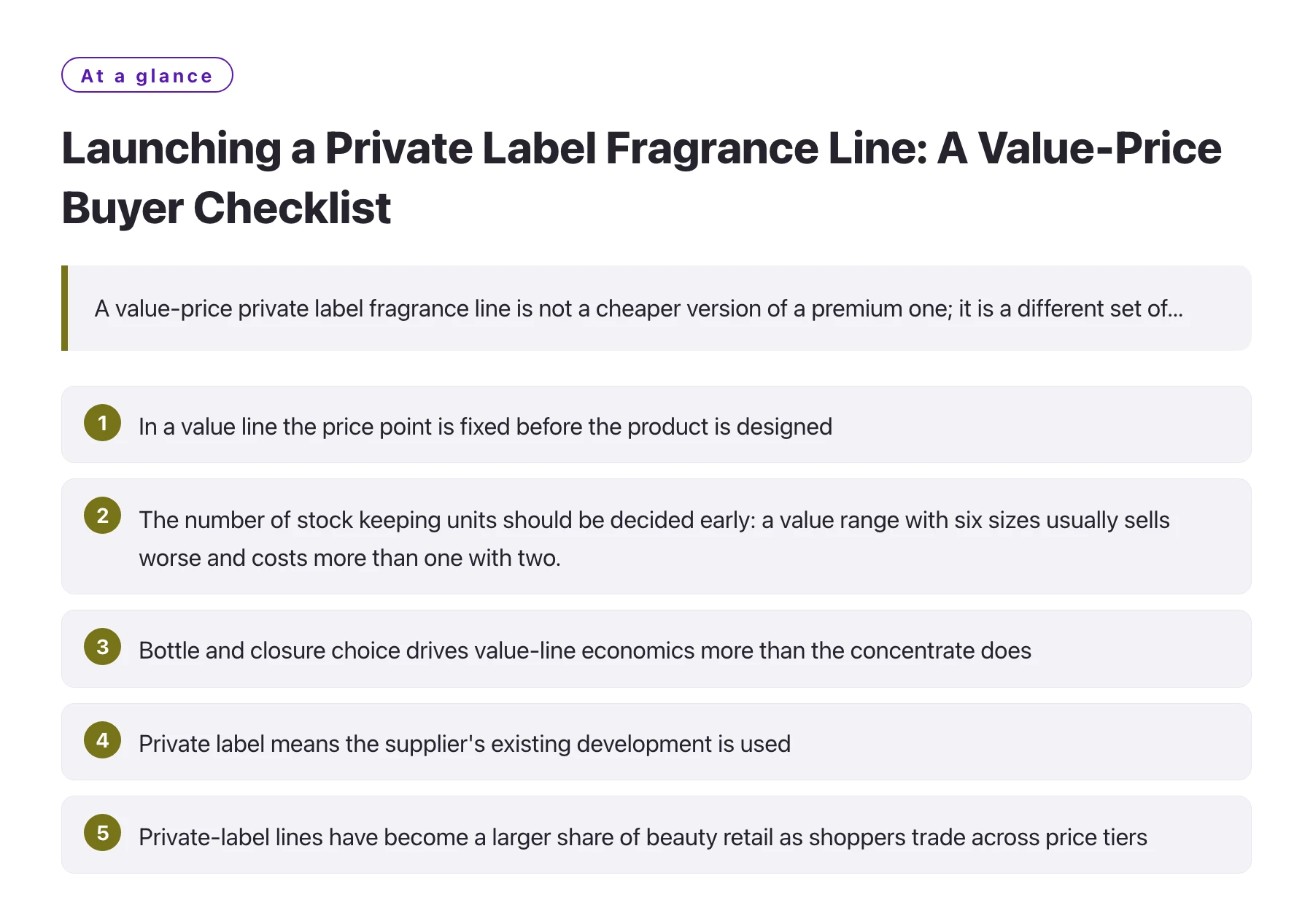
- In a value line the price point is fixed before the product is designed, so the useful brief starts with a cost ceiling per unit rather than a scent direction.
- The number of stock keeping units should be decided early: a value range with six sizes usually sells worse and costs more than one with two.
- Bottle and closure choice drives value-line economics more than the concentrate does, because glass, decoration and closures do not scale down as cheaply as fragrance does.
- Private label means the supplier's existing development is used, so the brand's differentiation has to come from the brief, the pack and the market position rather than from a new formula.
- Private-label lines have become a larger share of beauty retail as shoppers trade across price tiers, which makes the entry band more competitive than it was a decade ago [2].
- Packaging weight and material choices are now a cost and a reporting issue at the same time, so the format decision should be made with both in view [1].
- A first order should be sized to prove the line at retail, not to unlock the lowest possible unit price.
Private label fragrance has a reputation for being simple: choose a scent from a library, choose a bottle from a catalogue, print a label. In practice the simplicity sits on the factory side, and the difficulty sits with the buyer, because every choice made from a shortlist has a cost consequence that shows up much later.
This checklist is written from the retailer's side of the table, for an opening price point rather than a premium one. It assumes the line will be judged by sell-through and reorder behaviour rather than by the story attached to it.
Settle the price ladder before the scent
A value line begins with a retail price that the customer will compare against familiar brands on the same shelf. Working backwards from that price produces a cost ceiling per unit, and that ceiling should be written down before any scent is evaluated. Buyers who shop for a scent first usually fall in love with a direction that cannot be sold at the intended price, and the correction is always more expensive than the original brief would have been.
The ceiling should include everything that ships: concentrate, bottle, closure, decoration, carton, filling, and the freight allocation per unit. When a supplier quotes a value line, the useful comparison is not the concentrate price but the delivered cost of a saleable unit. Ask for that number explicitly, with the packaging assumption stated, so that two quotes can be compared without translating them first.
Leave a deliberate gap between the cost ceiling and the target cost. Value lines are sensitive to small changes, and a project that starts at the absolute ceiling has no room for the packaging substitution or the fill-size adjustment that almost always becomes necessary.
Choose two sizes, not five
A value range with five sizes multiplies tooling, labels, cartons and forecast complexity while adding very little to the shelf presence. Two sizes usually do more: one hero size at the price point that carries the line, and one smaller or larger size that gives the shopper a comparison. Every additional size should have to justify itself against the cost of holding it in the range.
Decide who owns the pack
In a private label arrangement the brand owns the identity and the supplier owns the production method. That split should be written down. If the retailer supplies artwork, the supplier needs to confirm it can be printed on the chosen component at the chosen quantity; if the supplier supplies artwork, the retailer needs to see a proof before the run. The boundary is where most first-order reprints originate.
Brief the scent in commercial language
A private label brief does not need a perfumer's vocabulary. It needs a market position and a performance expectation. "A clean citrus opening that reads fresh on a tester strip in a bright store, one that lasts through a commute without becoming heavy, at the entry price point" describes a product the supplier can match from a library. It also gives the buyer a way to reject a proposal without arguing about taste.
Where the line is intended to feel distinctive, the differentiation usually comes from an unexpected direction rather than an expensive material. A value line built around a single clear theme, such as a single floral or a single woody family, is easier to merchandise and easier for the shopper to remember than a range of six unrelated scents.
It is worth asking how a candidate supplier handles private label work in practice, because the label is used loosely in the market. Some suppliers match a library accord and produce it under the retailer's brand; others will develop a variation on a library theme. A supplier that presents itself as a private label partner for perfume lines should be able to describe which of those two routes it takes, what the retailer receives, and whether a competing retailer can buy the same accord.
Size the first order to prove the line
The temptation on a value line is to order large, because the unit price falls and the negotiation feels complete. The risk is that a value range is usually a range of guesses: which size sells, which scent sells, which store sells it. Ordering to prove the guesses is cheaper than ordering to optimise the price, particularly when the packaging lead time is long and a reprint is not quick.
A sensible first order covers enough stores to produce a readable result and leaves room for a second order placed before the shelf empties. Ask the supplier what the minimum quantity actually covers, and how it changes if the line later adds a size or a scent. Buyers who understand the minimum structure can plan a roll-out instead of negotiating each step. A useful reality check is to compare the minimum against what comparable lines have done at retail; retailers that publish brands Xuelei has manufactured for give one reference class, and asking how the supplier reads the comparison is more informative than the list itself.
The same question applies to lead times. On a value line the calendar matters more than usual, because the retail window is often tied to a season or a promotional cycle. Ask when the order has to be placed to hit the window, and then decide whether the line can be built in the available time or whether the launch should move. A late line at a good price is still a missed season.
Where the retailer already sources other categories from the same supplier network, it is worth asking how the sequence of approvals will be handled. Value lines fail on unanswered questions more often than on price, and the supplier's ability to explain how it will get a decision out of a busy buying team is a genuine signal of experience with Xuelei.
A short exercise that prevents most value-line surprises: write the retail price, the cost ceiling, the hero size and the launch window on one page, and refuse to change any of them without changing the others. Most of the damage in a value launch comes from moving one number and leaving the rest in place.
Sources
- HAPPI — Household & Personal Products Industry —— An industry magazine covering the household and personal care market, including fragrance, formulation and packaging.
- Mintel Press Centre —— Mintel's press releases on consumer and beauty market research, including fragrance and personal care trend reporting.
Frequently asked questions
What is the difference between private label and white label fragrance?
White label usually means a ready product sold under the retailer's name with minimal change. Private label usually means a supplier's development, packaging and filling are configured for the retailer's own brand, which may include a modified accord, custom pack and exclusivity terms. The distinction lives in the contract, not in the vocabulary.
How many scents should a value fragrance line launch with?
Fewer than most briefs propose. Three to five scents in two sizes is a common and workable shape for an opening range, because it gives the shopper a choice without doubling the forecast, the labels and the shelf space.
Can a value line use a distinctive scent?
Yes, and it usually should carry one clear idea rather than six unrelated directions. A single strong theme is easier to merchandise, easier to repeat in later ranges and easier for the shopper to describe to someone else.
What should be in the first order rather than delayed to the second?
The packaging decisions that carry long lead times and the compliance documentation that supports the label. Both are difficult to change retroactively. Scent extensions and additional sizes are the items that can safely wait for sell-through evidence.
How should a retailer compare two private label quotes fairly?
Compare the delivered cost of a saleable unit at the same volume, with the packaging assumption and fill size stated. Quotes that differ in carton, closure or decoration are not comparable until those differences are priced, and the cheapest concentrate is not the same as the cheapest product.